Before the Oxygen Saturation Drops: Recognizing Early Respiratory Deterioration
Sep 21, 2026
Respiratory season is approaching, and with it comes an increase in influenza, RSV, COVID-19, pneumonia, and exacerbations of chronic pulmonary disease. For nurses, this often means caring for more patients whose respiratory status can change quickly—sometimes before the monitor reflects just how sick they are becoming.
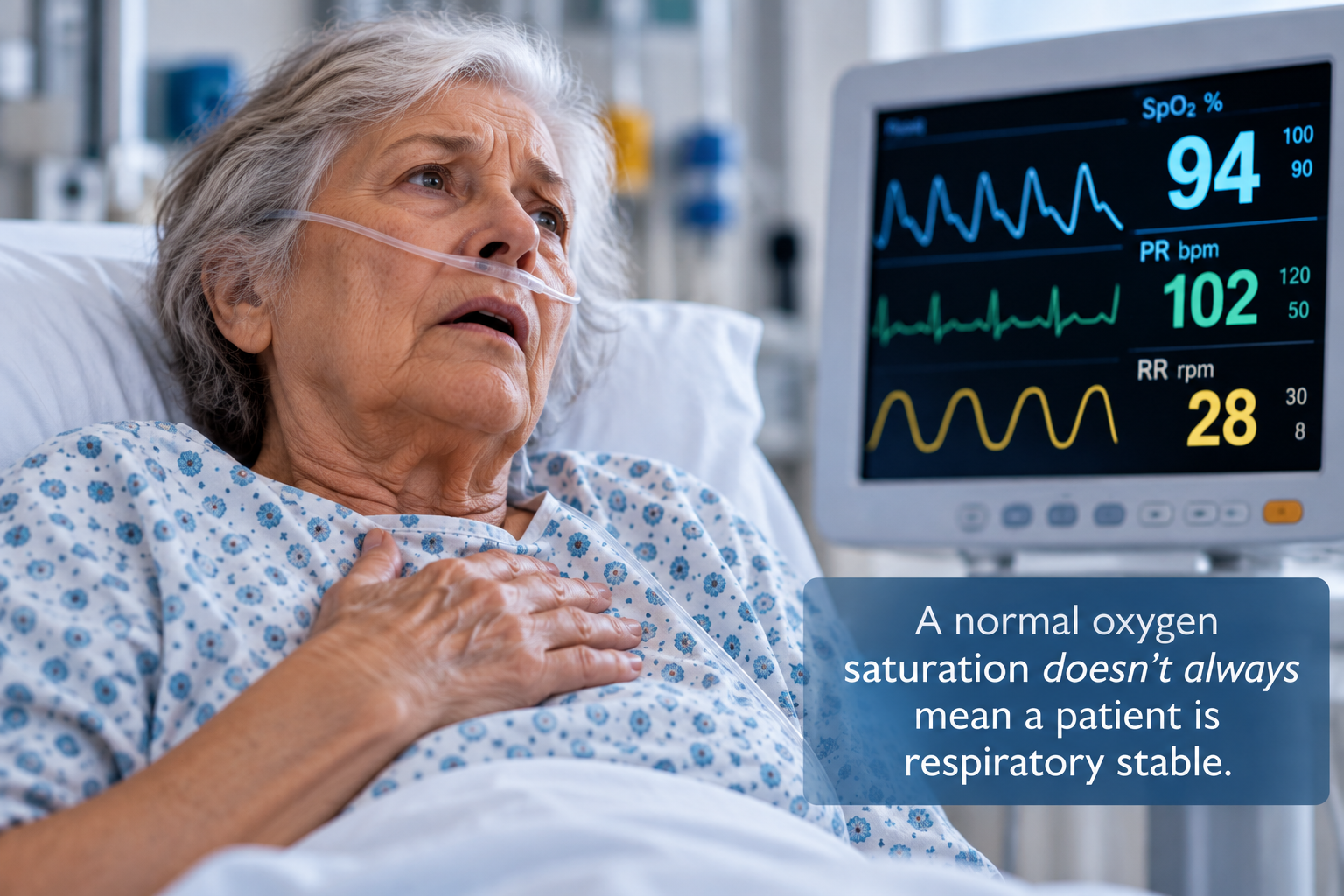
An oxygen saturation of 94% can look reassuring.
But what if the patient is breathing 28 times per minute to maintain it?
What if they are beginning to use accessory muscles, becoming less conversational, or showing subtle changes in mental status?
And what if, two hours later, their respiratory rate falls to 20—but instead of looking better, they are now drowsy and taking shallow breaths?
One of the most important principles in respiratory assessment is also one of the easiest to lose sight of during a busy shift:
A pulse oximeter measures oxygen saturation. It does not measure the amount of effort required to maintain that saturation, and it does not directly tell you whether the patient is ventilating adequately.
As respiratory season approaches, recognizing that distinction can make the difference between identifying deterioration early and recognizing it only after the patient has begun to decompensate.
The SpO₂ Can Be Reassuring While the Patient Is Not
Pulse oximetry has become so routine that it is easy for the number to become the respiratory assessment.
A saturation appears on the screen. It is within the expected range. The nurse moves on.
But oxygen saturation represents only one component of respiratory function.
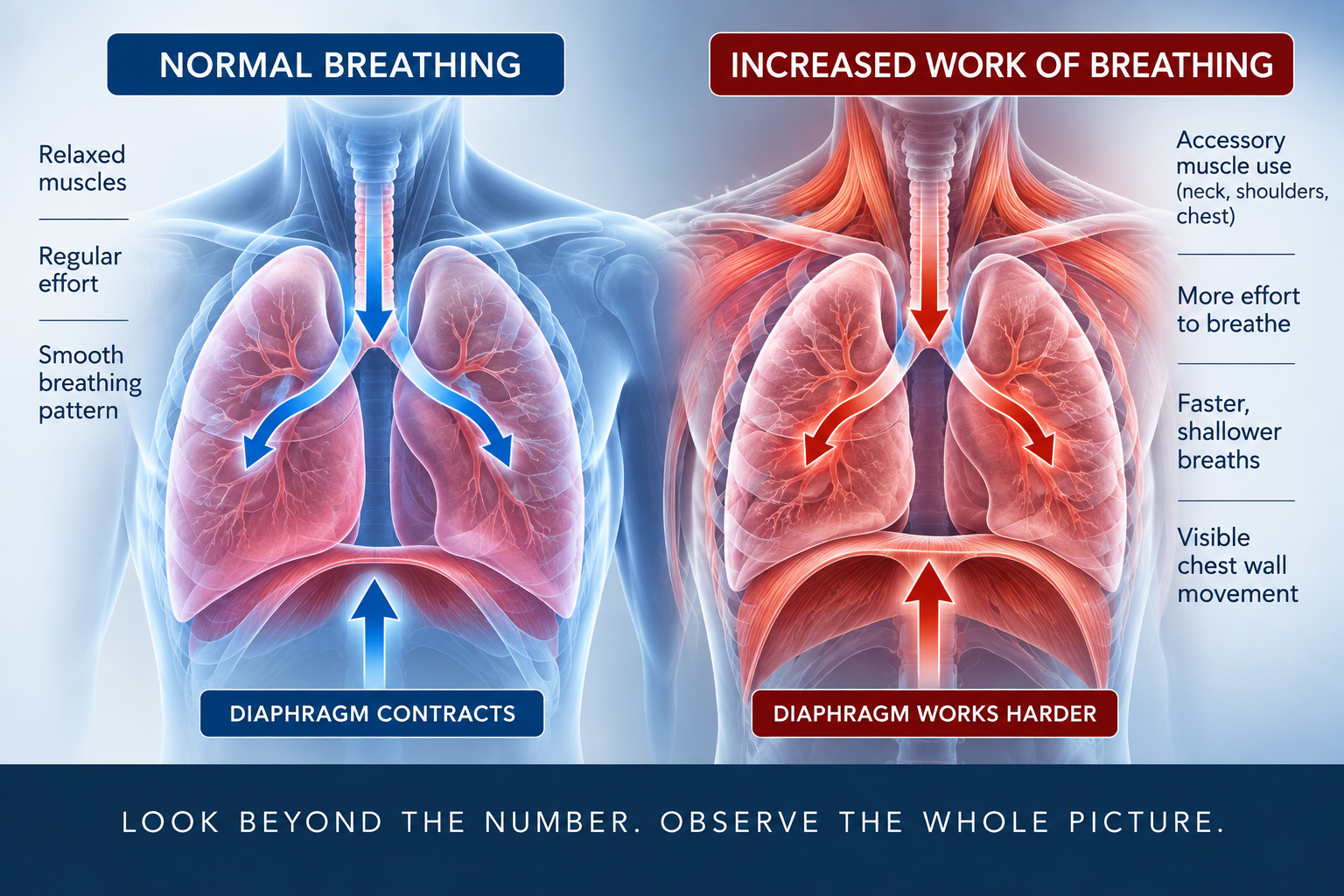
A patient may initially maintain an acceptable SpO₂ by compensating—increasing respiratory rate, increasing work of breathing, changing position, recruiting accessory muscles, or receiving supplemental oxygen. The number may therefore remain relatively stable while the physiologic effort required to maintain it is increasing.
That is why an experienced respiratory assessment asks a different question.
Not simply:
“What is the oxygen saturation?”
But:
“What is this patient having to do to maintain it?”
A patient sitting upright, breathing 30 times per minute and using accessory muscles to maintain an SpO₂ of 94% presents a very different clinical picture from a comfortable patient breathing 16 times per minute with the same saturation.
The monitor gives the same number.
The bedside assessment does not.
Oxygenation and Ventilation Are Not the Same Thing
This distinction becomes particularly important when assessing patients at risk for ventilatory failure.
Oxygenation refers to getting oxygen into the blood. Ventilation refers to moving air into and out of the lungs sufficiently to eliminate carbon dioxide.
Pulse oximetry provides information about oxygen saturation. It does not directly measure carbon dioxide clearance.
That means an apparently acceptable SpO₂ does not necessarily tell you that ventilation is adequate—particularly when a patient is receiving supplemental oxygen.
A patient can maintain oxygen saturation while ventilation worsens and carbon dioxide rises. Depending on the clinical situation, increasing somnolence, headache, confusion, shallow respirations, or declining responsiveness may become important clues that the problem is no longer simply oxygenation.
This is one reason nurses should resist allowing a single monitor value to overrule the clinical picture.
If the patient's neurological status and breathing pattern are deteriorating, an acceptable saturation should not automatically be interpreted as evidence of respiratory stability.
Respiratory Rate Is More Than a Number
Respiratory rate can be one of the earliest vital signs to change during clinical deterioration, yet it is also one of the easiest measurements to underestimate.
Consider a patient whose respiratory rate progresses from 18 to 22 to 26 breaths per minute over several hours.
Each individual measurement may not appear dramatic. The trend, however, tells a story.
The patient may be compensating for infection, hypoxemia, metabolic acidosis, pulmonary disease, pain, fever, or another physiologic stressor. The cause cannot be determined from respiratory rate alone, but the progression deserves attention.
This is where trending becomes more valuable than looking at isolated values.
Experienced nurses don't simply ask whether a vital sign falls inside or outside a reference range. They compare it with the patient's baseline, the previous assessment, the rest of the vital signs, and what they are observing at the bedside.
And there is another side to respiratory rate that can be even more concerning.
Sometimes the rate falls.
When a Lower Respiratory Rate Is Not an Improvement
Imagine a patient with a respiratory infection who has been breathing 30 to 32 times per minute for several hours.
Later, the respiratory rate is documented as 20.
At first glance, that looks like improvement.
But now the patient is increasingly drowsy. Respirations are shallow. Speech has decreased. The patient no longer appears to have the energy to sustain the same respiratory effort.
The question is no longer simply whether the respiratory rate improved.
The question becomes:
Did the patient's respiratory distress resolve—or is the patient becoming fatigued?
A declining respiratory rate accompanied by improving work of breathing, better mentation, improved comfort, and stabilization of other findings may indeed represent recovery.
A declining rate accompanied by shallow breathing, decreased responsiveness, worsening gas exchange, or reduced respiratory effort can mean something very different.
This is why respiratory assessment requires context.
Numbers don't deteriorate.
Patients do.
Work of Breathing May Tell the Story Before the Monitor Does
Before oxygen saturation changes significantly, the body may already be showing signs that breathing is becoming more difficult.
Watch the patient—not just the monitor.
Has the patient changed position to breathe more comfortably? Are they suddenly sitting upright when they normally tolerate lying back? Are accessory muscles becoming more prominent? Is breathing becoming visibly labored? Can the patient still speak comfortably in complete sentences? Are they pausing more frequently during conversation?
Even the patient's interaction with you may change.
A person who was talking easily an hour earlier may begin giving one-word answers—not because they have nothing to say, but because speaking requires respiratory effort they can no longer spare.
These observations can be particularly important when caring for patients who cannot clearly describe dyspnea.
Respiratory Infection May Not Look Like Respiratory Infection
Respiratory season presents another challenge: not every patient with a serious respiratory infection arrives with the classic picture of fever, productive cough, and obvious shortness of breath.
Older adults and medically complex patients may present differently.
The first indication of pneumonia, influenza, RSV, COVID-19, or another infection may be a change in function or cognition.
A resident who normally transfers independently suddenly needs assistance.
A patient who usually eats well refuses breakfast.
Someone who is normally oriented becomes confused.
A patient becomes unusually fatigued, experiences a fall, or simply “isn't themselves.”
None of those findings independently diagnoses a respiratory infection. But a change from baseline should prompt the nurse to look deeper rather than dismissing it because the classic symptoms are absent.
This is particularly important in long-term care and other settings where nurses know their patients' usual functional and cognitive baselines.
Sometimes the nurse who recognizes that “something is different” is identifying deterioration before the disease has fully declared itself.
The Patient in Front of You Matters More Than an Isolated Number
Consider this scenario.
A 74-year-old patient with COPD develops a respiratory infection. Earlier in the shift, the patient has an SpO₂ of 94% on prescribed supplemental oxygen and a respiratory rate of 30. Breathing is visibly labored, but the patient remains alert and conversational.
Two hours later, the SpO₂ is still 94%.
The respiratory rate is now 20.
If those two numbers were reviewed without context, the patient might appear to be improving.
But the nurse notices something else.
The patient is now drowsy. Respirations are shallower. Conversation has nearly stopped, and the patient responds only after repeated verbal stimulation.
The oxygen saturation did not provide the warning.
The patient's clinical trajectory did.
This is the point at which assessment has to move beyond the monitor. Depending on the clinical setting, orders, scope of practice, and patient's condition, further evaluation may include a more comprehensive respiratory and neurological assessment, escalation to the appropriate clinician or rapid-response process, and additional diagnostic evaluation such as blood-gas analysis.
The important clinical principle is not to diagnose the cause from the bedside based on one finding.
It is to recognize that the patient's condition is moving in the wrong direction.
Technology Should Support Clinical Judgment—Not Replace It
Pulse oximetry is enormously valuable, but like every monitoring tool, it has limitations.
Readings can be affected by factors such as motion, poor peripheral perfusion, sensor positioning, and other technical or physiologic variables. When a displayed value does not fit the patient's clinical appearance, nurses should consider the reliability of the measurement rather than automatically accepting the number.
More importantly, even a technically accurate SpO₂ answers only a specific question.
It does not assess mental status.
It does not tell you how exhausted the respiratory muscles are becoming.
It does not directly measure ventilation.
It does not explain why the respiratory rate is changing.
And it cannot tell you whether today's value represents a significant departure from that patient's baseline.
Those pieces come from nursing assessment and clinical reasoning.
Respiratory Season Rewards the Nurse Who Notices the Trend
Experienced nursing assessment is often less about identifying one dramatic abnormality and more about recognizing a pattern before it becomes dramatic.
The respiratory rate is creeping upward.
The patient is requiring more effort to breathe.
Speech is becoming shorter.
Activity tolerance has declined.
Mental status is subtly changing.
Oxygen requirements are increasing.
The patient who was compensating earlier is beginning to look tired.
None of these findings should be interpreted in isolation, and none automatically establishes a diagnosis. Together, however, they may tell a very different story from the oxygen saturation displayed on the monitor.
As influenza, RSV, COVID-19, pneumonia, and other respiratory illnesses become more common during respiratory season, nurses will encounter patients at many different points along that continuum.
Some will arrive obviously ill.
Others won't.
And sometimes the earliest warning will not be a flashing monitor or a dramatically abnormal vital sign.
It will be the nurse at the bedside who recognizes:
This patient is working harder than they were before.
This patient's baseline has changed.
This trend doesn't make sense if they're getting better.
That is the difference between simply collecting respiratory data and interpreting what the data means in the context of the patient.
And that is where experienced nursing judgment matters most.
Take the next step with continuing education designed for LVNs who serve with purpose.